



Parasite
Antiparasitics are a class of medications which are indicated for the treatment of parasitic diseases such as nematodes, cestodes, trematodes, and infectious protozoa.
Parasite Isoform Specific Products
All Product Categories
-
Parasite Related Products (2567)
Related Products (2567)

-
Related Compound Screening Libraries (1)
-
Parasite Isoform Comparison
-
Penicolinate B
 0 ImagesCat. No.: HY-N12230CAS No.: 1418291-70-9Penicolinate B is a picolinic acid derivative that can be isolated from Penicillium sp. Penicolinate B exhibits antimalarial activity (IC50: 1.40 μg/mL), antitubercular activity (MIC: 25.0 μg/mL), activity against Bacillus cereus (IC50: 25.0 μg/mL), and activity against Candida albicans (IC50: 1.45 μg/mL). Penicolinate B also has certain cytotoxicity against cancer cells such as MCF-7, KB, and NCI-H187. Penicolinate B can be used in research on malaria, tuberculosis, bacterial/fungal infections and tumors.
-
NPD8790
 0 ImagesCat. No.: HY-158423CAS No.: 615281-26-0NPD8790 is a species selective mitochondrial respiratory complex I inhibitor with an IC50 of 2.4 µM for C. elegans complex I. NPD8790 is more selective for nematode species mitochondria than human, bovine, and mouse mitochondria. NPD8790 is an anthelmintic that kills adult soil-transmitted helminths.
-
Catechu extract
 0 ImagesCat. No.: HY-N20283Catechu extract is an extract of catechu (Areca catechu L.) that can be used in research on parasitic diseases and depression.
-
Antileishmanial agent-44
 0 ImagesCat. No.: HY-184214Antileishmanial agent-44 is a histone deacetylase inhibitor targeting Leishmania donovani Sir2, with an IC50 of 0.652 μM against amastigotes. Antileishmanial agent-44 elevates ROS levels to induce oxidative stress, which causes mitochondrial membrane potential depolarization, cytochrome c release, phosphatidylserine externalization and DNA fragmentation, triggers apoptosis-like cell death, and arrests the cell cycle. Antileishmanial agent-44 upregulates the expression of Th1-type cytokines and NO in macrophages, reshapes host immune responses to eliminate intracellular parasites. Antileishmanial agent-44 inhibits parasites in infected golden hamsters in vivo. Antileishmanial agent-44 can be used for the research of visceral leishmaniasis.
-
Phebestin
 0 ImagesCat. No.: HY-122248CAS No.: 187402-73-9Phebestin is a compound with antimalarial activity that has an inhibitory effect on Plasmodium and has shown good results in in vitro and in vivo experiments. It can also bind to related enzymes of Plasmodium.
-
PIM-IN-3
 0 ImagesCat. No.: HY-178979CAS No.: 3082559-91-6PIM-IN-3 (Compound 50) is an orally active new anti-intestinal worm drug. PIM-IN-3 exhibits strong inhibitory activity in vitro, especially for whipworms (IC50 = 6.6 µM). PIM-IN-3 has low cytotoxicity. PIM-IN-3 can be used in the research of gastrointestinal nematode diseases.
-
Acetylastragaloside I
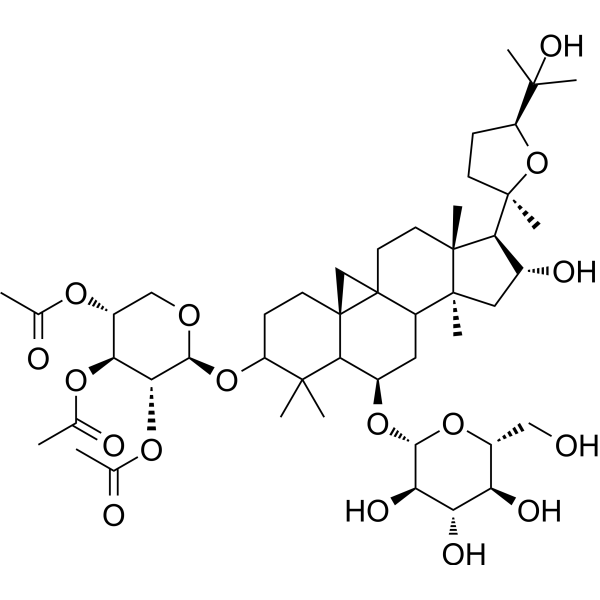 0 ImagesCat. No.: HY-N1985CAS No.: 84687-47-8Acetylastragaloside I is a glycoside that can be isolated from the roots of Astragalus baibutensis. Acetylastragaloside I is the first cycloartane-type triterpene with remarkable trypanocidal activity with IC50 values of 9.5 and 5.0 μg/mL for T. brucei rhodesiense and T. cruzi, respectively. Acetylastragaloside I can be used for the research of trypanosome infection.
-
Negundoside
 0 ImagesCat. No.: HY-182295CAS No.: 82451-20-5Negundoside is an iridoid glycoside compound. Negundoside exhibits hepatoprotective effects, reduces ROS, lipid peroxidation and intracellular calcium ion levels, and prevents the decrease of mitochondrial membrane potential (MMP) and apoptosis (apoptosis). Negundoside has neuroprotective effects, improves behavioral deficits, alleviates oxidative damage, and ameliorates cerebral infarction. Negundoside also possesses antibacterial and antiparasitic activities.
-
Naloxonazine
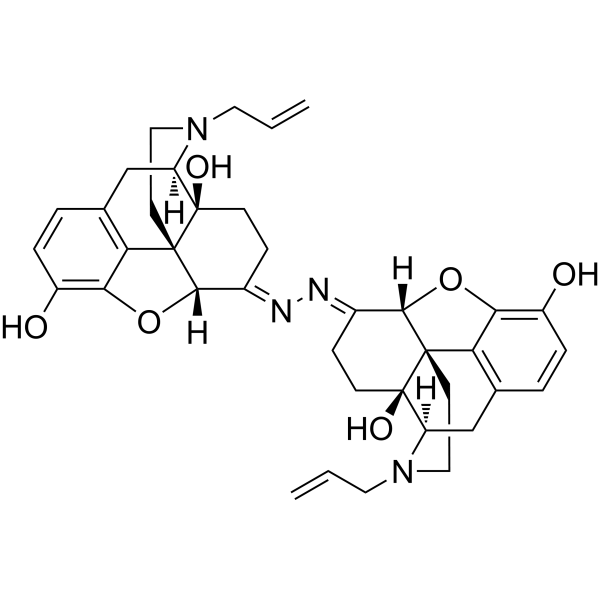 0 ImagesCat. No.: HY-137180CAS No.: 82824-01-9Naloxonazine is a potent and selective opiate mu-1 antagonist that can also affect leishmania by regulating host coding function.
-
(Rac)-Efavirenz
 0 ImagesCat. No.: HY-10572BCAS No.: 177530-93-7Synonyms: (Rac)-DMP 266; (Rac)-EFV; (Rac)-L-743726
-
Rabdosiae rubescentis herba extract
 0 ImagesCat. No.: HY-N20422Synonyms: Rabdosia rubescens extractRabdosiae rubescentis herba extract (Rabdosia rubescens extract) is an extract of Rabdosia rubescens (Hemsl.) Hara, which has various biological activities such as antibacterial, antiparasitic, anti-inflammatory and anticancer effects.
-
M&B 5124
 0 ImagesCat. No.: HY-131508CAS No.: 15382-90-8M&B 5124 is a potent inhibitor of Schistosoma mansoni in mice.
-
Antitrypanosomal agent 23
 0 ImagesCat. No.: HY-172951Antitrypanosomal agent 23 is an antitrypanosomal agent. Antitrypanosomal agent 23 has activity against intracellular amastigotes of T. cruzi in LLC-MK2 and C2C12 cells (IC50: 0.10 and 0.11 μM). Antitrypanosomal agent 23 is a weak inhibitor of Recombinant trans-sialidase from T. cruzi (TcTS) (IC50: 1.1 mM).
-
ACS03
 0 ImagesCat. No.: HY-177958CAS No.: 2227022-64-0ACS03 is a hybrid thiophene-acridine compound. ACS03 induces an increase in lactate dehydrogenase, glutathione S-transferase, and AChE activities. ACS03 has antileishmanial activity. ACS03 exhibits selective anti-cancer effects against colon carcinoma.
-
Acivicin (Standard)
 0 ImagesCat. No.: HY-W016586RCAS No.: 42228-92-2Synonyms: AT-125 (Standard); U-42126 (Standard)Articaine (Standard) is the analytical standard of Articaine. This product is intended for research and analytical applications. Articaine (Hoe-045 free base) is an amide agent that can suppress or relieve pain. containing an ester group, reversibly binding to the α-subunit of the voltage-gated sodium channels within the inner cavity of the nerve, can provide effective pain relief. Articaine ameliorates LPS-induced acute kidney injury via inhibition of NF-κB activation and the NLRP3 inflammasome pathway.
-
DMU759
 0 ImagesDMU759 is a Lysyl-tRNA synthetase 1 (KRS1) inhibitor. DMU759 has potent anti-kinetoplastid activity against Trypanosoma cruzi , Trypanosoma brucei and Leishmania donovani. DMU759 significantly reduces parasitemia in acute Chagas disease mice model. DMU759 can be used for parasitic infection like Chagas disease research.
-
Fenbutatin oxide-d30
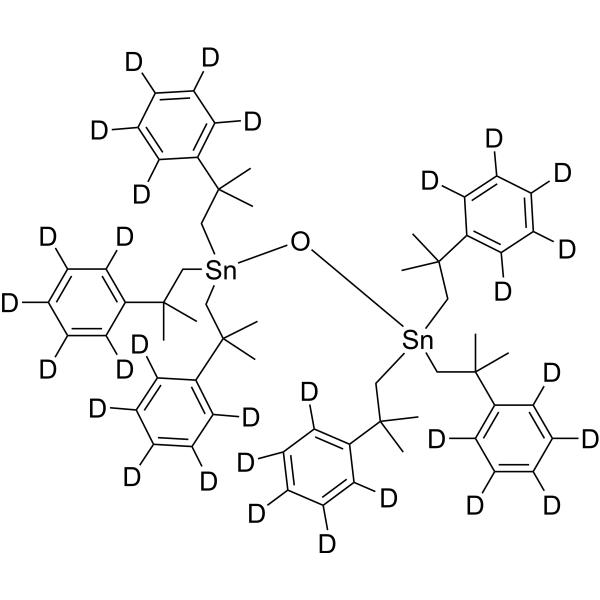 0 ImagesCat. No.: HY-133004SFenbutatin oxide-d30 is the deuterium labeled Fenbutatin oxide. Fenbutatin oxide is an organotin acaricide.
-
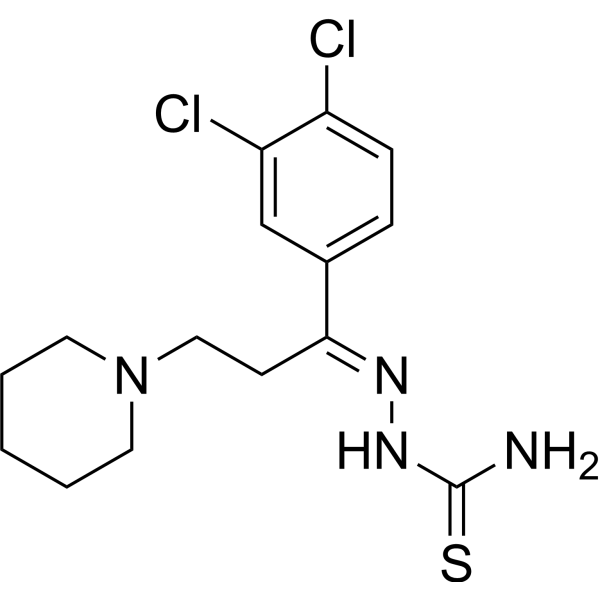
Trypanothione synthetase-IN-4
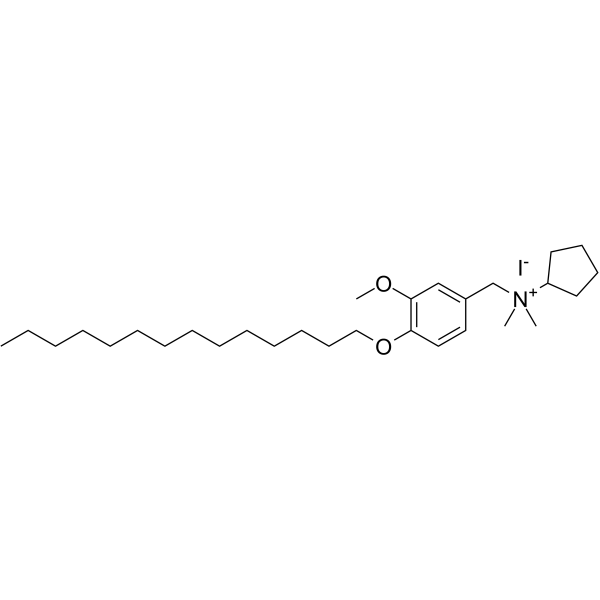 0 ImagesCat. No.: HY-151149CAS No.: 3033799-62-8Trypanothione synthetase-IN-4 is a L. infantum trypanothione synthetase (TryS) inhibitor, and the activity is dependent on the concentration of the polyamine substrate. Trypanothione synthetase-IN-4 has potent antileishmanicidal activity with an EC50 value of 0.6 μM and a selectivity index of 35. Trypanothione synthetase-IN-4 can be used for the research of leishmaniasis.
-
Deferitazole
 0 ImagesCat. No.: HY-101672CAS No.: 945635-15-4Synonyms: FBS 0701Deferitazole (FBS 0701) is an orally active iron chelator. Deferitazole shows antimalarial activity and Can be used for study of malaria .



